
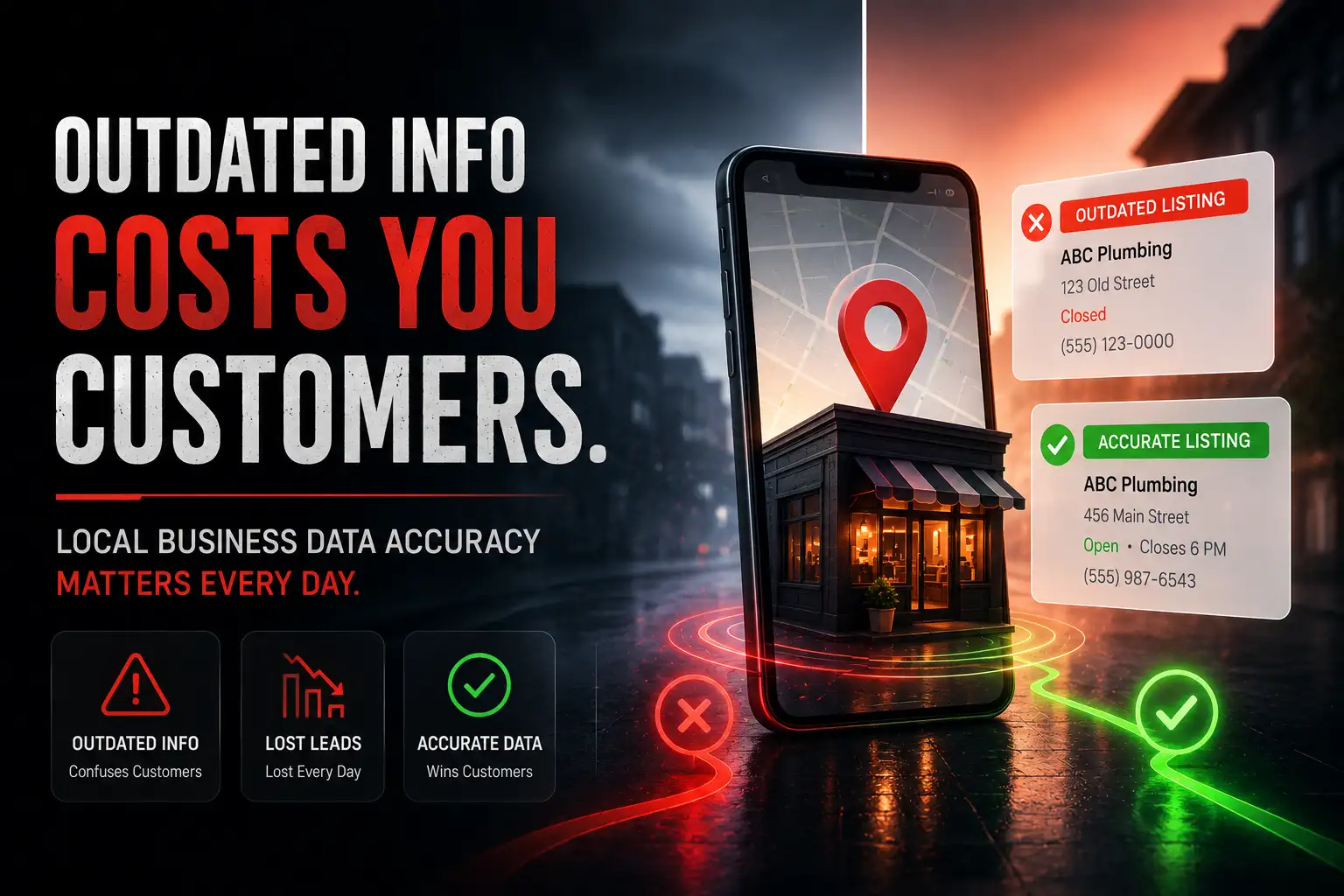
Outdated business information wrong hours, changed phone numbers, old addresses silently drives away customers and undermines local SEO rankings. Learn how to audit, correct, and maintain accurate business data everywhere.
Every day that your business information is inaccurate somewhere online, you are losing potential customers. Not theoretically actually, measurably. Customers who call a phone number that’s no longer in service. Customers who drive to an address that’s changed. Customers who arrive at a closed business based on outdated hours. These experiences don’t just lose a single sale; they create lasting negative impressions that generate bad reviews and erode the trust-based reputation you’ve worked to build.
The scope of the business data accuracy problem is larger than most business owners realize. Business information exists in dozens of places: your Google Business Profile, your website, your Biz Lookup Now listing, Yelp, Facebook, Apple Maps, Bing Places, dozens of secondary directories, and the major data aggregators that feed information to hundreds of additional platforms. When you update your information in one place, every other location remains outdated until you manually correct it or it gets corrected through data syndication processes that can take weeks or months.
The most common data accuracy failures are: phone number changes that weren’t universally updated, address changes that left the old address live on multiple platforms, business hours changes (seasonal or permanent) that were only updated in one or two places, and business name changes or rebrands that created split citation profiles.
Conducting a comprehensive data accuracy audit starts with searching for your business name in Google Maps, Yelp, Apple Maps, and Bing Maps to compare the information displayed. Follow this with a formal citation audit using BrightLocal or Whitespark, which will surface discrepancies across a much broader range of platforms. Document every inaccuracy and prioritize corrections by platform authority.
Building an ongoing data maintenance process prevents future accuracy drift. Whenever any business information changes, create a checklist of every platform that requires updating and work through it systematically before considering the update complete. Many listing management platforms offer bulk update capabilities that apply changes across multiple directories simultaneously a significant time saver for businesses with complex multi-platform presences.
Frequently Asked Questions
Q: How long does it take for corrected business information to propagate across all platforms?
A: Changes on Google Business Profile typically appear within a few days. Changes through major data aggregators can take two to eight weeks to propagate to downstream platforms. High-priority, high-visibility corrections should always be made directly on individual platforms rather than waiting for aggregator syndication.
Q: What’s the most dangerous piece of inaccurate business information from a customer experience perspective?
A: Incorrect business hours are typically the most damaging inaccuracy they directly cause customers to arrive when you’re closed or to call outside your available hours. Phone number errors are a close second. Both should be prioritized at the top of any data accuracy correction effort.
Q: Can outdated information on low-authority directories actually affect my search ranking?
A: Yes. Even low-authority directories contribute NAP data to the aggregators and data ecosystems that feed major platforms. Persistent inconsistencies on these secondary platforms can create conflicting citation signals that reduce Google’s confidence in your business data and negatively influence your local ranking.