
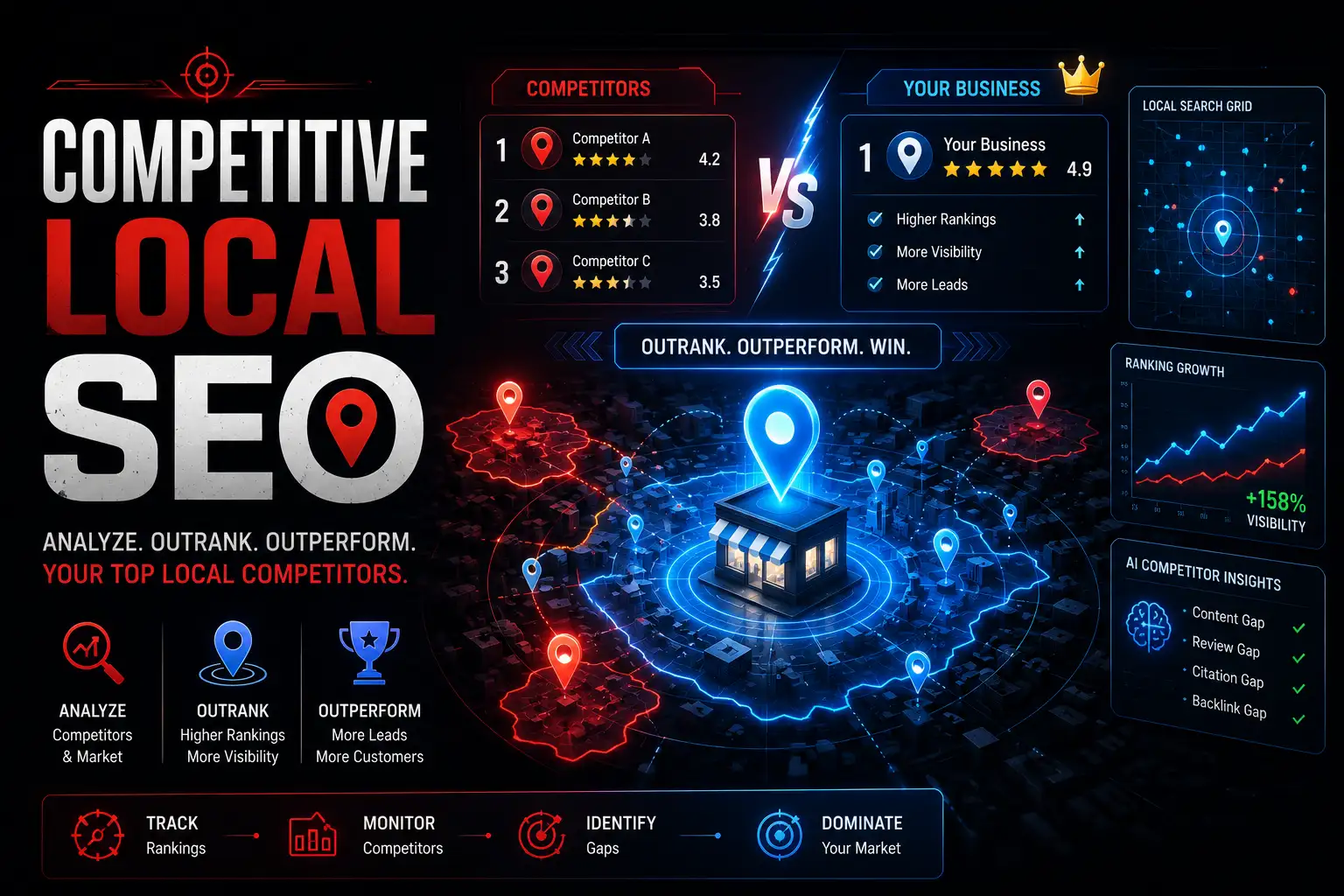
Knowing what your competitors are doing in local SEO gives you a precise roadmap to beating them. Learn how to audit competitor listings, reverse-engineer their rankings, and systematically outperform them.
Every competitive local market has leaders businesses that consistently appear at the top of local search results, capture a disproportionate share of new customer inquiries, and seem to effortlessly maintain their visibility advantage. Here’s the truth: their dominance isn’t effortless, and it isn’t mysterious. It’s the result of specific, analyzable SEO investments that you can study, understand, and surpass.
Competitive local SEO analysis starts with identifying your true local search competitors the businesses that appear in the local three-pack and top organic results for your primary service keywords. These may or may not be your traditional business competitors. A business you’ve never encountered in person might be your most significant online competitor if they consistently outrank you for your highest-value search terms.
For each identified competitor, analyze five dimensions: GBP completeness and activity (how often they post, how many photos they have, how regularly they respond to reviews), review portfolio strength (count, average rating, recency, content quality), citation profile (which major directories they’re listed on, whether their NAP data is consistent), website authority (domain rating, number of backlinks, quality of local content), and content strategy (frequency of blog publishing, topic focus, keyword targeting).
This competitive analysis immediately surfaces the specific gaps between your current optimization and your competitors’ best practices. Maybe they have twice as many reviews. Maybe they publish weekly blog posts and you don’t publish at all. Maybe their website has 30 local backlinks and yours has three. Each gap is a specific, actionable opportunity.
Prioritize competitive gaps by impact and achievability. Review count and recency can be addressed relatively quickly with a proactive review generation campaign. Closing a content publishing gap takes longer but delivers compounding returns. Building backlink parity is the longest-term effort but creates a durable ranking advantage once achieved.
Monitor competitor rankings and activities on an ongoing basis not obsessively, but quarterly. Markets evolve, new competitors enter, and existing competitors change their strategies. Staying aware of the competitive landscape allows you to respond to meaningful shifts before they threaten your ranking position.
Frequently Asked Questions
Q: What’s the fastest way to close a review gap with a stronger competitor?
A: Implement a systematic, multi-channel review request process immediately. Every satisfied customer is a potential review create the infrastructure to ensure you’re capturing them consistently. Businesses that treat review generation as a daily operational priority can close significant review gaps within 90 to 120 days.
Q: Should I follow exactly what my competitors are doing or differentiate?
A: Do both. Match competitor best practices in the fundamentals (complete GBP, strong reviews, citation consistency) to establish competitive parity. Then differentiate in content, specialization, and brand voice to give searchers a specific reason to choose you over an equally well-optimized competitor.
Q: Are there ethical lines in competitive local SEO analysis?
A: Absolutely. Analyzing publicly visible information rankings, reviews, website content, link profiles is entirely ethical. Reporting competitors for policy violations you’re not certain they’ve actually committed, attempting to generate fake negative reviews for competitors, or any form of negative SEO targeting are unethical practices with significant legal and reputational risks.